
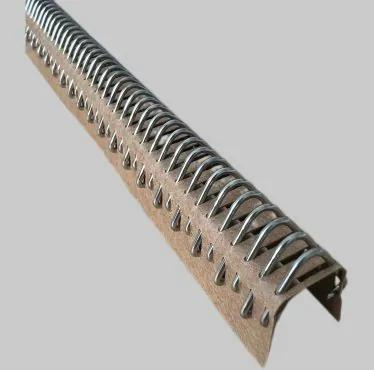
Conveyor systems are expected to operate consistently, but belts inevitably require inspection, repair, or replacement as operating hours accumulate. For manufacturers in logistics, filter mesh, laundry, corrugated cardboard, and other light industrial applications, the method used to join belt ends can directly affect how easily maintenance teams respond to these situations. Mechanical fastening provides a practical alternative to permanent splicing methods by allowing belt joints to be installed, opened, and replaced with comparatively straightforward procedures.
For procurement teams evaluating a conveyor belt fastener manufacturer, the key consideration is therefore not simply the initial purchase price. Belt compatibility, joint design, installation requirements, material selection, replacement convenience, and supplier support all influence the long-term maintenance process. Industry guidance also identifies proper fastener selection and installation as important factors in splice performance, with belt tension, belt thickness, and pulley diameter among the technical considerations that need to be evaluated.
Why Mechanical Fastening Supports Flexible Conveyor Maintenance
One of the main advantages of mechanical fastening is accessibility. When a belt is damaged or a joint requires attention, maintenance personnel can work directly on the fastening system instead of depending exclusively on a permanent joining process. This can be particularly useful for operations where minimizing equipment downtime is an important maintenance objective.
Mechanical fastening can also provide greater flexibility when belts are changed between production requirements. Different belts may have different thicknesses, materials, and operating conditions, so fastening systems need to be selected according to the actual belt specification rather than treated as interchangeable components. For light-duty applications, mechanical fasteners commonly include hook and lacing designs that connect belt ends with a hinge pin.
For manufacturers producing conveyor belts, this flexibility also has implications for product design and after-sales support. A fastening solution that accommodates different belt configurations can help manufacturers serve a wider range of downstream applications without relying on one fixed joint configuration.
Selecting Conveyor Belt Fasteners for Maintenance Requirements
When comparing conveyor belt fasteners, technical compatibility should remain the starting point. Belt thickness, fastener material, joint configuration, pulley characteristics, and the operating environment can all influence the appropriate selection. An unsuitable fastener can contribute to premature splice wear, mistracking, or interference with other conveyor components.
Intake’s product portfolio provides several fastening options for different requirements. Its official product category lists Carded Wire Belt Fasteners made from 304S stainless steel, Reinforced Wire Hook Belt Fasteners made from 304S, the INTAKE CR Series using 316L stainless steel with galvanized steel, and Hinge Pins made from 304S. The listed packaging specification for these products is 12 pieces per box.
Its wire hook fastening systems are designed with a low-profile configuration and are available in different wire diameters, materials, strip lengths, and styles. Intake lists custom length options from 101 mm to 1524 mm (4 to 60 inches), allowing belt manufacturers to consider different width requirements. The company also states that its wire hook fasteners are available in 304 and 316 stainless steel.
These options can be relevant to manufacturers supplying lightweight conveyor belts for logistics, laundry, and filter mesh applications. However, selection should still be based on the actual belt construction and operating conditions rather than simply choosing a fastener by appearance or unit cost.
Maintenance Efficiency Depends on Installation Quality
Fastener selection alone does not determine joint performance. The preparation of the belt ends and the accuracy of installation are equally important. Technical guidance from conveyor specialists notes that improperly squared belt ends can create uneven tension and tracking problems, while incorrect fastener installation can contribute to premature splice failure.
This is why maintenance flexibility works best when supported by suitable installation equipment and procedures. Intake provides both belt fastening systems and manual or hydraulic machine systems, allowing customers to select equipment according to their production and installation requirements. Its product range therefore extends beyond individual fasteners to include tools intended to support the fastening process.
For belt manufacturers, this broader solution can simplify sourcing because fastening components and installation equipment can be evaluated together. Operational video tutorials and technical support can also help distributors and production teams standardize installation practices across different orders or customer applications.
A Practical Supplier Strategy for Belt Manufacturers
For B2B buyers, supplier evaluation should extend beyond product availability. Consistent material quality, customization capability, technical support, delivery performance, and pricing can influence the total cost of maintaining inventory and supporting customers.
Intake identifies independent R&D, professional production equipment, competitive pricing, and pre- and after-sales service among its business capabilities. Its website also states a minimum order quantity of 50 boxes and highlights customization across models, sizes, lengths, and materials.
For manufacturers serving filter mesh, washing belts, and light-duty industrial conveyor applications, these capabilities can be useful when customer requirements vary from one belt specification to another. Intake also focuses on distributor and agent relationships, making supplier cooperation relevant not only for direct users but also for companies building regional product channels.
For maintenance-driven conveyor applications, the value of mechanical fastening ultimately comes from flexibility: the ability to select an appropriate joint, install it correctly, inspect it efficiently, and replace it when required. Working with an experienced conveyor belt fastener manufacturer such as Intake can give B2B buyers access to multiple fastening configurations while keeping technical and sourcing considerations connected.