
To understand the properties of a 3D printing material, it helps to start with its chemical composition. Polylactic acid (PLA) is a thermoplastic polyester commonly produced from lactic acid, which can be obtained by fermenting sugars derived from renewable feedstocks such as corn starch or sugarcane. The exact formulation and environmental impact depend on the manufacturing process and any additives used.
Agricultural facilities extract natural plant starches—typically derived from corn, sugarcane, or cassava roots—and subject them to bacterial fermentation. This fermentation produces lactic acid, which is subsequently polymerized into a solid plastic. Because of its organic origins, this PLA filament offers a sustainable footprint and exceptional dimensional stability during thermal extrusion.
The Manufacturing Process: From Starch to Polymer
The production cycle of this thermoplastic begins in agricultural fields. The primary raw material is raw biomass that is naturally rich in starch. Through an industrial wet-milling process, the starch is separated from the surrounding organic plant matter and broken down into simple sugars, primarily dextrose.
Specialized microorganisms ferment the sugars to produce lactic acid. In a common industrial route, the lactic acid is converted into lactide, a cyclic intermediate, which is then polymerized through ring-opening polymerization to produce PLA. Manufacturers control the process conditions to achieve the molecular properties required for the intended application.
After polymerization, the raw plastic is cooled, extruded, and chopped into small, manageable resin pellets. During the final manufacturing phase into standard PLA Filaments, technicians may introduce specific chemical additives to modify the material’s natural toughness. The end result is a highly stable, rigid polymer that softens predictably when introduced to a heated nozzle.
SUNLU Technical Specifications and Hardware Alignment
For reliable fabrication, understanding the basic chemical origin is insufficient; operators must align their slicer software profiles with precise technical tolerances. Variations in polymer density, tensile strength, and ideal extrusion temperatures directly impact the structural integrity of the final printed part.
By choosing filament products from SUNLU, users can review the manufacturer’s published specifications and recommended printing settings to help achieve more consistent results. The technical data table below outlines the specific physical and thermal limits for standard SUNLU PLA products, sourced directly from their official brand specifications.
| Core Technical Parameter | Official SUNLU Specification |
| Material Density | 1.23 g/cm³ |
| Dimensional Tolerance | 1.75 mm ± 0.02 mm |
| Tensile Strength | 40±6 MPa |
| Flexural Strength | 65±6 MPa |
| Heat Deflection Temperature | 55±5 °C |
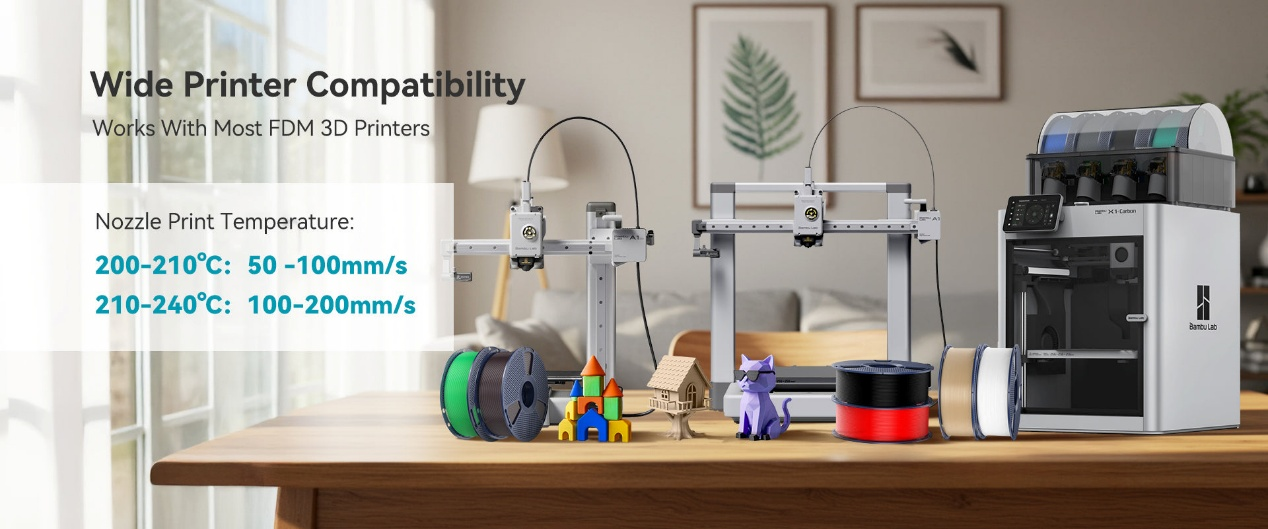
| Nozzle Printing Temperature | 200–210°C (at 50–100 mm/s print speed) |
| Heated Bed Temperature | 50–60°C |
Consistent filament diameter helps maintain predictable material feeding and extrusion. Large diameter variations can affect the amount of material delivered to the hotend and may contribute to under-extrusion, over-extrusion, or feeding problems. However, print quality also depends on the extruder design, filament condition, and slicer settings.
Physical Properties, Shelf Life, and Environmental Impact
To effectively utilize any polymer, operators must objectively evaluate its inherent physical properties and lifecycle characteristics. Unlike high-temperature engineering plastics, this bio-based material possesses a relatively low glass transition temperature, typically ranging between fifty-five and sixty-five degrees Celsius.
This specific thermal characteristic dictates that the plastic will begin to soften and structurally deform if exposed to environments exceeding this threshold. However, this same low thermal threshold makes the material incredibly easy to process, requiring minimal heating bed temperatures.
PLA can biodegrade under suitable conditions, but the rate and extent of degradation depend on the formulation and the surrounding environment. Industrial composting conditions may support degradation for some PLA products, whereas ordinary soil, home compost, or other disposal environments may produce different results. Filament shelf life also varies by product and storage conditions, so users should follow the manufacturer’s guidance rather than assume a universal expiration period.
To help preserve filament quality, store the spool in a cool, dry place and use a sealed bag or container with desiccant when appropriate. Follow the manufacturer’s storage recommendations for the specific product. During printing, maintain suitable ventilation and follow the printer and filament manufacturer’s safety guidance; odor alone is not a reliable indicator of emissions or safety.
Extrusion Characteristics and Food Safety Compliance
PLA is widely used in FDM 3D printing because many formulations are relatively easy to process and exhibit lower shrinkage than some other thermoplastics. These characteristics can help reduce warping in many applications, while layer adhesion and surface quality still depend on the filament formulation and printing conditions.
PLA’s relatively low shrinkage can help reduce warping in many common printing applications, and many standard PLA prints can be produced without a heated enclosure. Final dimensional accuracy still depends on the printer, material formulation, model geometry, and printing settings. When selecting a reliable PLA 3D printer filament, operators should check the recommended printing settings and confirm that the filament diameter matches their printer’s requirements.
Food-contact suitability should not be assumed from the base polymer alone. It depends on the specific filament formulation, colorants and additives, printing equipment, post-processing, intended use, and applicable food-contact requirements. Users should verify product-specific documentation before considering a 3D-printed item for food contact.
For applications involving potential food contact, users should check the nozzle manufacturer’s material specifications and consider the risk of contamination from previous printing materials. A suitable nozzle and appropriate cleaning procedures may help reduce certain contamination risks, but they do not by themselves establish that a printed object is safe for food contact. Product-specific documentation and applicable regulatory requirements should guide the final decision.
Conclusion
Understanding the chemical composition, organic origins, and precise physical limits of additive materials empowers operators to make informed production decisions. Transforming from simple plant starch into a highly precise polymer, this bioplastic represents a leap forward in sustainable manufacturing.
By acknowledging its specific thermal limitations and leveraging its exceptional dimensional stability, professionals can utilize this material for a massive array of reliable prototyping applications. Continuously aligning hardware settings with authoritative official material specifications ensures that complex digital models are transformed into highly accurate physical components efficiently and safely.
By integrating these organic, easy-to-process polymers into their daily workflow, creators and facility managers can achieve exceptional print quality while maintaining a highly environmentally conscious approach to modern physical production.