
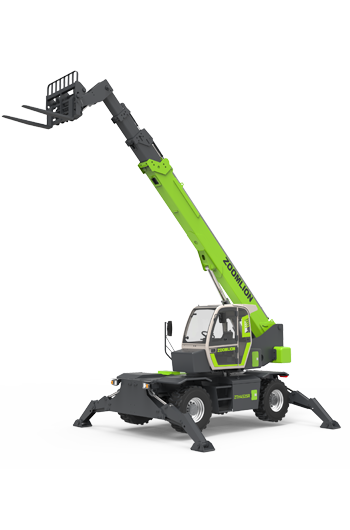
A rotating telehandler can combine material handling, lifting and positioning, but offers that look similar on paper may differ substantially in operating range and ownership requirements. Procurement teams should compare more than headline lifting capacity. A useful review should examine load performance at different boom positions, reach, dimensions, attachments, operating conditions, documentation, parts availability and service support.
- Compare Rated Capacity With the Actual Load
Start with the loads the machine will handle most often. Rated capacity is important, but it should not be treated as one number that applies to every boom position. A telehandler’s lifting capability changes with boom extension, height and load placement, so buyers should examine the manufacturer’s load charts for intended tasks.
Build the comparison around real project loads: pallets, structural components, mechanical equipment or other materials. Record typical and maximum weights, lifting height, placement distance and handling frequency. The offer should then be checked against those conditions rather than the machine’s headline capacity alone.
- Look at Reach as Carefully as Capacity
Reach determines where a load can be placed without moving the chassis. Procurement teams should compare maximum lift height and maximum forward reach, then examine the corresponding capacity at those positions. This matters when projects require delivery over obstacles, across slabs or into elevated work areas.
A slewing telehandler can extend the working envelope because the upper structure can rotate while the chassis remains positioned. Buyers should still verify the applicable load chart and operating limits for each combination of reach, height, rotation and attachment. Rotation adds flexibility, but it does not remove the need to respect rated capacities.
- Check Footprint, Travel and Site Conditions
A machine’s overall dimensions can determine whether a promising offer is practical. Compare length, width, height, wheelbase, ground clearance and turning radius with site gates, transport routes, access roads, storage areas and working lanes. Weight may also affect transportation arrangements and ground-loading considerations.
Mobility requirements should be documented before purchasing. Check drive configuration, steering modes, gradeability, traction and travel speed against site surfaces and gradients. Procurement teams should also consider whether the machine must move between work zones or stay positioned while completing several lifting tasks.
- Review Attachments and Configuration
Two offers with similar base-machine specifications may provide different value when their attachment packages differ. Identify the tools required, such as forks, platforms, buckets or other approved attachments, and confirm how each affects capacity and operating range.
Attachment compatibility should be verified with the manufacturer rather than assumed from a similar machine. The comparison should also include attachment-change procedures, storage requirements and any additional training or documentation. A broader configuration can matter to fleet owners because it may allow one machine to cover several project tasks.
- Compare Support Before Comparing Price
Purchase price is only one part of a slewing telehandler offer. Procurement teams should request information about warranty terms, preventive maintenance, technical documentation, training, spare-parts supply, service response, dealer coverage and expected support for the operating region.
Support requirements should be written into the tender or quotation request. This makes different offers easier to compare and reduces ambiguity after delivery. For international purchases, buyers should also verify certification and documentation for the destination market, along with the supplier’s process for technical issues and parts requests.
Where the ZTH4525R Fits
The ZTH4525R from Zoomlion Access is a rotating telehandler with a maximum working height of 24.8 m and a rated capacity of 4,500 kg. Its specification also lists 2,000 kg lift capacity at maximum height, 19 m maximum forward reach and 300 kg lift capacity at maximum reach. These figures give procurement teams concrete reference points when reviewing offers.
Its configuration includes 4×4 drive, hydrostatic transmission and 360° continuous rotation. Zoomlion Access lists a 32 km/h maximum drive speed, 82 kN maximum traction force, 4.2 m outside turning radius and three steering modes: front-wheel, four-wheel and crab steering. These specifications can be matched against site logistics and maneuvering requirements.
Product Details Buyers Can Put on the Comparison Sheet
The ZTH4525R measures 9.28 m long, 2.48 m wide and 3.15 m high, with a 3.07 m wheelbase and 0.35 m minimum ground clearance. The machine weighs 17,000 kg. Its standard floating fork is 1,220 mm × 150 mm × 50 mm, while optional platforms, buckets and booms are available according to the official product page.
The power specification lists Cummins QSF3.8_02, Cummins F4.5 or Cummins F3.8_01 engine options, with rated power of 93, 89 or 90 kW. Hydraulic flow and pressure are listed as 107 L/min and 280 bar. The machine is CE certified, providing another item for buyers to verify against destination-market requirements.
Building a Complete Offer Review With Zoomlion Access
Zoomlion Access currently lists eight telehandlers, divided into non-rotating and rotating models, including the ZTH4518R and ZTH4525R. Their broader portfolio covers scissor lifts, articulating and telescopic boom lifts, spider lifts, vertical mast lifts, vehicle-mounted boom lifts, forklifts and telehandler attachments.
For international buyers, Zoomlion Access states that they support customers through a global service network, with more than 30 overseas subsidiaries and 17+ overseas service bases. Their website also states service targets including a 10-minute response to service requirements, 24-hour general fault handling and 24-hour delivery of commonly used accessories. Buyers should confirm applicable support levels for their market and contract.