
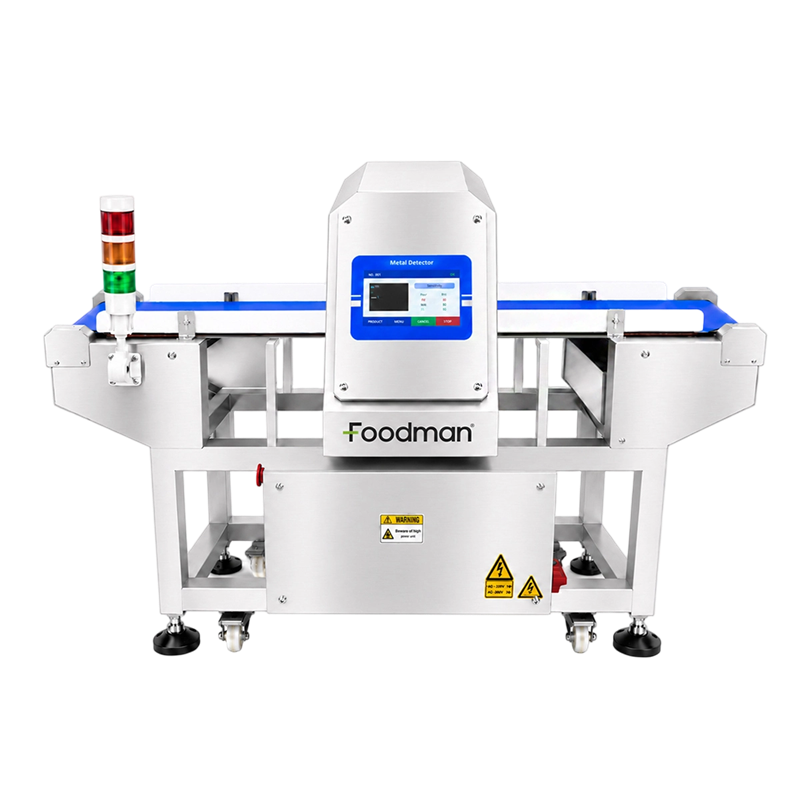
Metal contamination can enter food during cutting, grinding, mixing, conveying, or packaging. Detecting it reliably requires more than placing a sensor beside a production line. A food metal detector creates a controlled electromagnetic field, monitors changes within that field, and interprets those changes to identify metallic contamination.
Understanding this sequence helps food manufacturers see how the equipment actually protects products and why installation, product characteristics, and signal processing all matter.
What Happens Inside the Detection Aperture?
At the center of a metal detection system is the detection aperture through which food products pass. A transmitter coil generates an electromagnetic field inside this opening, while receiver coils continuously monitor the field for disturbances. In a balanced system, the receiver signals remain stable while uncontaminated products move through the inspection zone.
The basic principle behind a food metal detector is therefore signal comparison rather than visual recognition. The equipment does not need to see a fragment. Instead, it observes how an object changes the electromagnetic conditions inside the aperture. This makes the technology suitable for packaged and unpackaged products moving continuously through a production line.
Coil design also matters because the aperture determines how the electromagnetic field interacts with the product. Smaller openings can generally support greater sensitivity, while the product size and presentation must still allow stable, uninterrupted movement through the inspection area.
How Metal Creates a Detectable Signal
Metallic contaminants interact with the electromagnetic field generated by the detector. As a conductive object enters the field, electrical currents are induced within the metal. These currents create their own electromagnetic response, disturbing the balanced signal monitored by the receiver coils.
The resulting disturbance is converted into an electronic signal that the detector can analyze. Ferrous metals, non-ferrous metals, and stainless steel can produce different signal characteristics, so the system must be configured to recognize the relevant contamination types. Modern systems use digital signal processing and related detection technologies to distinguish meaningful signals from background interference.
For manufacturers, this explains why a food metal detector is not simply an on-off sensor. Its electronics continuously evaluate the inspection signal while products move through the aperture. The objective is to identify a disturbance associated with metal while avoiding unnecessary responses to normal product characteristics.
From Signal Change to Automatic Rejection
Detection is only one part of the operating sequence. Once the processed signal exceeds the programmed detection threshold, the control system identifies the product as potentially contaminated and activates the configured rejection mechanism. Depending on the production setup, this may involve an air blast, pusher, or another automated device.
Timing becomes critical at this stage. The contaminated item must be associated with the correct detection event and removed without unnecessarily affecting neighboring products. Conveyor speed, product spacing, and reject-device configuration therefore form part of the overall inspection process rather than being separate mechanical concerns.
A properly integrated food metal detector can operate continuously as products pass through the inspection point. The system effectively creates a closed sequence: field generation, signal monitoring, disturbance recognition, decision-making, and product removal. This sequence allows contamination control to take place directly within production rather than relying entirely on downstream manual inspection.
Why Food Products Can Complicate Detection
The detector responds not only to metal. Certain foods can also influence the electromagnetic signal. Moisture, salt, temperature, and other conductive properties may create what is commonly called the product effect. High-moisture or high-salt foods such as meat, cheese, and pickled products can generate signals that interfere with metal detection.
This creates a technical challenge. If the product itself produces a strong signal, a small contaminant may become harder to distinguish from the background. Excessive interference can also produce false rejects, where acceptable products are incorrectly identified as contaminated.
Modern systems address this problem through techniques such as multi-frequency operation, phase-sensitive processing, and product-specific parameter learning. These methods help the detector separate normal product signals from disturbances caused by actual metal contamination.
Consequently, a food metal detector must be considered in relation to the food being inspected. A setting that works well for a dry snack may not provide the same signal conditions for wet meat or salty cheese.
Turning Detection Principles into Reliable Line Inspection
Reliable detection depends on keeping the physical inspection conditions stable. Product presentation should remain consistent, the conveyor should transport items through the aperture predictably, and the inspection environment should minimize unnecessary electromagnetic interference. Conveyor construction and product positioning can directly influence detection performance.
Routine testing also confirms that the system continues to respond as expected. Reference test pieces representing ferrous, non-ferrous, and stainless-steel contaminants can be used to check detection performance.
Regular cleaning is equally important because food residues around the tunnel and conveyor can interfere with stable operation or create hygiene problems.
Foodman approaches automated weighing and inspection equipment from a production-line perspective, where consistent product handling is essential to dependable downstream decisions. In a combined inspection workflow, stable conveying and controlled product presentation can support more repeatable detection conditions.
Making the Detection Process Work Consistently
The operating principle of a food metal detector is straightforward, but dependable performance comes from controlling every stage of the signal chain. The transmitter establishes the electromagnetic field, the receiver coils identify disturbances, and digital processing determines whether those disturbances indicate contamination.
Food manufacturers should therefore view metal detection as a complete inspection process rather than a standalone sensor. Product composition, aperture size, conveyor movement, environmental conditions, detection settings, and rejection timing all influence how effectively the system performs.
For production teams evaluating inspection equipment, understanding these interactions makes technical specifications easier to interpret. Foodman Vision can support automated production environments where inspection must operate alongside controlled material flow, while the referenced metal detection solutions demonstrate how electromagnetic sensing can be integrated into food processing lines.
Ultimately, the effectiveness of a food metal detector comes from its ability to turn a small electromagnetic disturbance into a reliable production decision. When field generation, signal analysis, product handling, and rejection are properly coordinated, metallic contamination can be identified and removed before affected products continue further through the manufacturing process.