
The right water park supplier is the one whose demonstrated work and agreed responsibilities match the development being proposed. Selection becomes more reliable when investors first define the work required, then compare evidence against that brief. A product list is useful after those priorities have been established.
A hotel retrofit, an enclosed venue and a destination park will not ask the same questions in the same order. Their constraints give different weight to access, building clearance, equipment choice and wider planning. The comparison needs to preserve those differences while making each proposal understandable.
Decide Which Requirements Could Change the Shortlist
Shortlisting can start with the requirement most likely to rule an option out. A retrofit may depend on an existing connection or a restricted installation route. The investor can ask each candidate to explain its response to that particular condition before comparing optional features.
The same priorities can be given to competing water park manufacturers. That prevents one proposal being assessed for a complete development while another is assessed only for the equipment. A useful shortlist records the requirement each candidate is being asked to satisfy and the evidence needed to assess it.
A water park supplier reviewing a retrofit can begin with anchors, clearance and installation access. Master planning and the complete attraction mix become central questions for a new destination development. Neither review is made complete simply by borrowing the criteria used for a different project type.
Fixed site constraints establish the starting point for supplier selection. An unresolved fixed constraint remains visible before the team compares optional features. The preferred proposal needs to answer the difficult conditions as well as the elements that are easy to illustrate in a presentation.
Request Evidence That Addresses Those Requirements
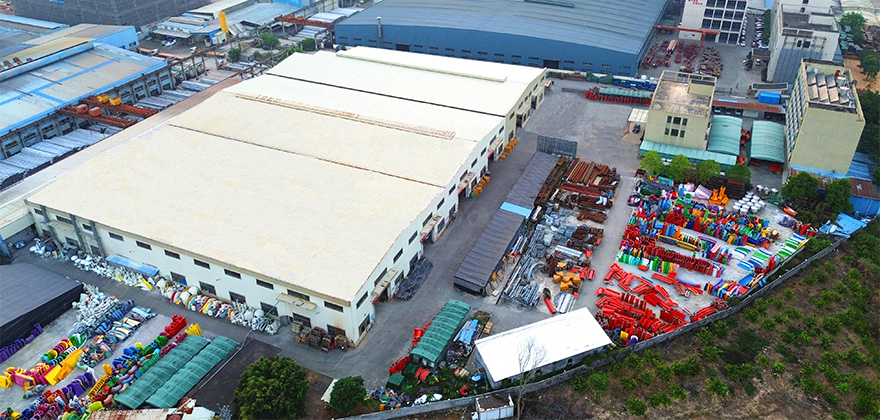
Manufacturing claims can be examined against an identifiable production facility and the work proposed for the order. Jinchao operates a manufacturing base of approximately 36,000 m². Its customised design and equipment production can be discussed together, with the required attraction package kept explicit.
When reviewing water park manufacturers, an investor can request a layout addressing comparable restrictions and a relevant operator reference. Those are different forms of evidence. A drawing explains a proposed arrangement; an operator can discuss the experience of receiving and using a particular installation.
Jinchao’s wider project experience exceeds 300 developments. Its Myanmar reference, for example, covers approximately 20,000 m² and includes more than ten attraction types. That case can inform a discussion of a mixed equipment package without establishing the appropriate mix for every project of similar area.
Investors who contact Jinchao can attach the site conditions to the question the reference is meant to answer. A supplier discussion then has a specific comparison to make. The relevant evidence concerns the task under consideration, with the remaining differences identified for the new development.
Compare Responsibilities beside the Equipment
The scope offered by water park manufacturers needs to explain where their work meets that of local contractors. Design, production, installation guidance and ongoing support are separate capabilities to examine. A broad description of service leaves the purchasing team with further questions about the resources actually included.
The one-year warranty runs from installation, while lifetime technical support is a Jinchao service. The purchase discussion can record their application to the chosen equipment package and clarify the resources for overseas installation, including the costs that remain the buyer’s responsibility under the agreed scope.
A technical team can contact Jinchao about the proposed interface between supplied equipment and local work. Named parties, drawing references and installation responsibilities make the agreement’s site interfaces traceable. An agreed boundary allows the investor to place both the equipment purchase and surrounding work in the project programme.
Aftercare also has practical details. The enquiry can request written spare-part availability and identify how an operating issue reaches the appropriate contact. An operator needs to be able to use that arrangement after opening, not merely recognise an after-sales heading in the original proposal.
Different reviewers can examine the same proposal for different purposes. The investor follows the quoted scope, the local technical team checks the site interfaces, and the future operator examines the information and support needed after handover.
Resolve the Items That Could Reverse the Decision
The final comparison can focus on the questions capable of changing the preferred option. A missing installation resource, an unsuitable access assumption or an unclear supply inclusion has a different consequence from a colour preference that remains open for design.
An amended proposal can change the comparison even when its headline price stays similar. The review can identify the revised inclusion or assumption, then check whether it affects the requirement that originally put that candidate ahead.
An investor may contact Jinchao with the relevant drawings and attachments to resolve a specific outstanding item. The request can state the decision affected and the information still needed. That gives a technical response a place in the selection process rather than treating every enquiry as general product research.
The strongest proposal is ready to be discussed as an agreement: the selected equipment, the site it serves and the responsibilities surrounding it are identifiable. A suitable water park supplier can then be chosen against that defined purchase, with evidence supporting the decision and unresolved conditions carried explicitly into the next step.